Problem of The Day: Path with Maximum Probability
6 min read
1357 words
Problem Statement
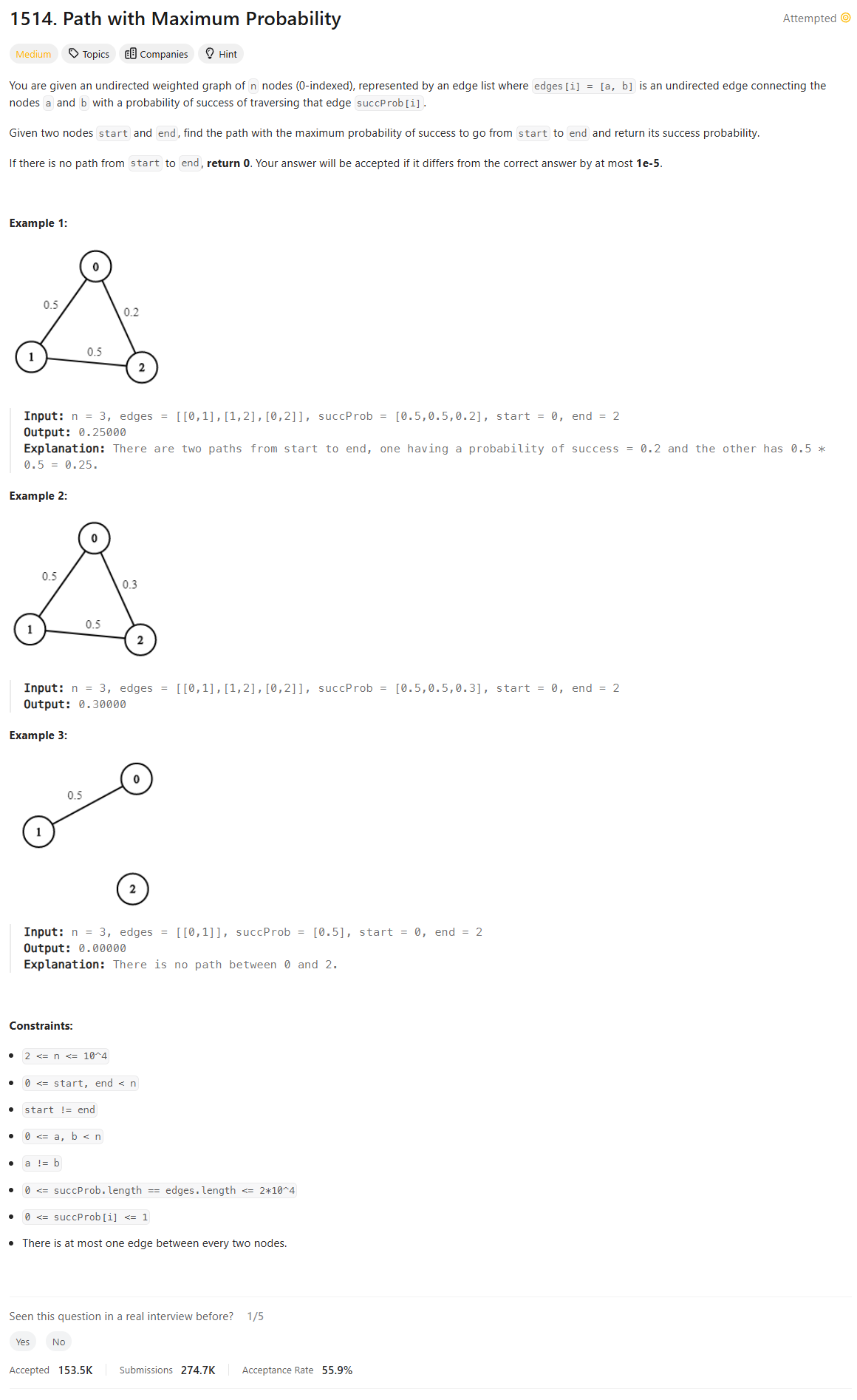
Brute Force - TLE
class Solution:
    def maxProbability(self, n: int, edges: List[List[int]], succProb: List[float], start_node: int, end_node: int) -> float:
        graph = {i: [] for i in range(n)}
        for i, [x, y] in enumerate(edges):
            graph[x].append([y, succProb[i]])
            graph[y].append([x, succProb[i]])

        def dfs(start, end, graph, visited, curr):
            if start == end:
                dfs.max_prob = max(dfs.max_prob, curr)
                return
            visited.add(start)
            for nei, p in graph[start]:
                if nei not in visited:
                    dfs(nei, end, graph, visited, curr * p)
            visited.remove(start)

        dfs.max_prob = float('-inf')
        dfs(start_node, end_node, graph, set(), 1)
        return dfs.max_prob if dfs.max_prob != float('-inf') else 0.0
Dijkstra’s algorithm review
import heapq

def dijkstra(graph, start):
    # Initialize distances and priority queue
    distances = {vertex: float('infinity') for vertex in graph}
    distances[start] = 0
    priority_queue = [(0, start)]

    while priority_queue:
        current_distance, current_vertex = heapq.heappop(priority_queue)

        # Nodes can get added to the priority queue multiple times. We only process a vertex the first time we remove it from the priority queue.
        if current_distance > distances[current_vertex]:
            continue

        for neighbor, weight in graph[current_vertex].items():
            distance = current_distance + weight

            # Only consider this new path if it's better
            if distance < distances[neighbor]:
                distances[neighbor] = distance
                heapq.heappush(priority_queue, (distance, neighbor))

    return distances

# Example usage
graph = {
    'A': {'B': 1, 'C': 4},
    'B': {'A': 1, 'C': 2, 'D': 5},
    'C': {'A': 4, 'B': 2, 'D': 1},
    'D': {'B': 5, 'C': 1}
}

print(dijkstra(graph, 'A'))
Editorial
Approach 1: Bellman-Ford Algorithm
class Solution:
    def maxProbability(self, n: int, edges: List[List[int]], succProb: List[float], start: int, end: int) -> float:
        max_prob = [0] * n
        max_prob[start] = 1

        for i in range(n - 1):
            # If there is no larger probability found during an entire round of updates,
            # stop the update process.
            has_update = 0
            for j in range(len(edges)):
                u, v = edges[j]
                path_prob = succProb[j]
                if max_prob[u] * path_prob > max_prob[v]:
                    max_prob[v] = max_prob[u] * path_prob
                    has_update = 1
                if max_prob[v] * path_prob > max_prob[u]:
                    max_prob[u] = max_prob[v] * path_prob
                    has_update = 1
            if not has_update:
                break

        return max_prob[end]
Approach 2: Shortest Path Faster Algorithm
class Solution:
    def maxProbability(self, n: int, edges: List[List[int]], succProb: List[float], start: int, end: int) -> float:
        graph = defaultdict(list)
        for i, (a, b) in enumerate(edges):
            graph[a].append([b, succProb[i]])
            graph[b].append([a, succProb[i]])

        max_prob = [0.0] * n
        max_prob[start] = 1.0

        queue = deque([start])
        while queue:
            cur_node = queue.popleft()
            for nxt_node, path_prob in graph[cur_node]:

                # Only update max_prob[nxt_node] if the current path increases
                # the probability of reach nxt_node.
                if max_prob[cur_node] * path_prob > max_prob[nxt_node]:
                    max_prob[nxt_node] = max_prob[cur_node] * path_prob
                    queue.append(nxt_node)

        return max_prob[end]
Approach 3: Dijkstra’s Algorithm
class Solution:
    def maxProbability(self, n: int, edges: List[List[int]], succProb: List[float], start: int, end: int) -> float:
        graph = defaultdict(list)
        for i, (u, v) in enumerate(edges):
            graph[u].append((v, succProb[i]))
            graph[v].append((u, succProb[i]))

        max_prob = [0.0] * n
        max_prob[start] = 1.0

        pq = [(-1.0, start)]
        while pq:
            cur_prob, cur_node = heapq.heappop(pq)
            if cur_node == end:
                return -cur_prob
            for nxt_node, path_prob in graph[cur_node]:

                if -cur_prob * path_prob > max_prob[nxt_node]:
                    max_prob[nxt_node] = -cur_prob * path_prob
                    heapq.heappush(pq, (-max_prob[nxt_node], nxt_node))
        return 0.0
Leave a comment