Problem of The Day: Word Search II
Problem Statement
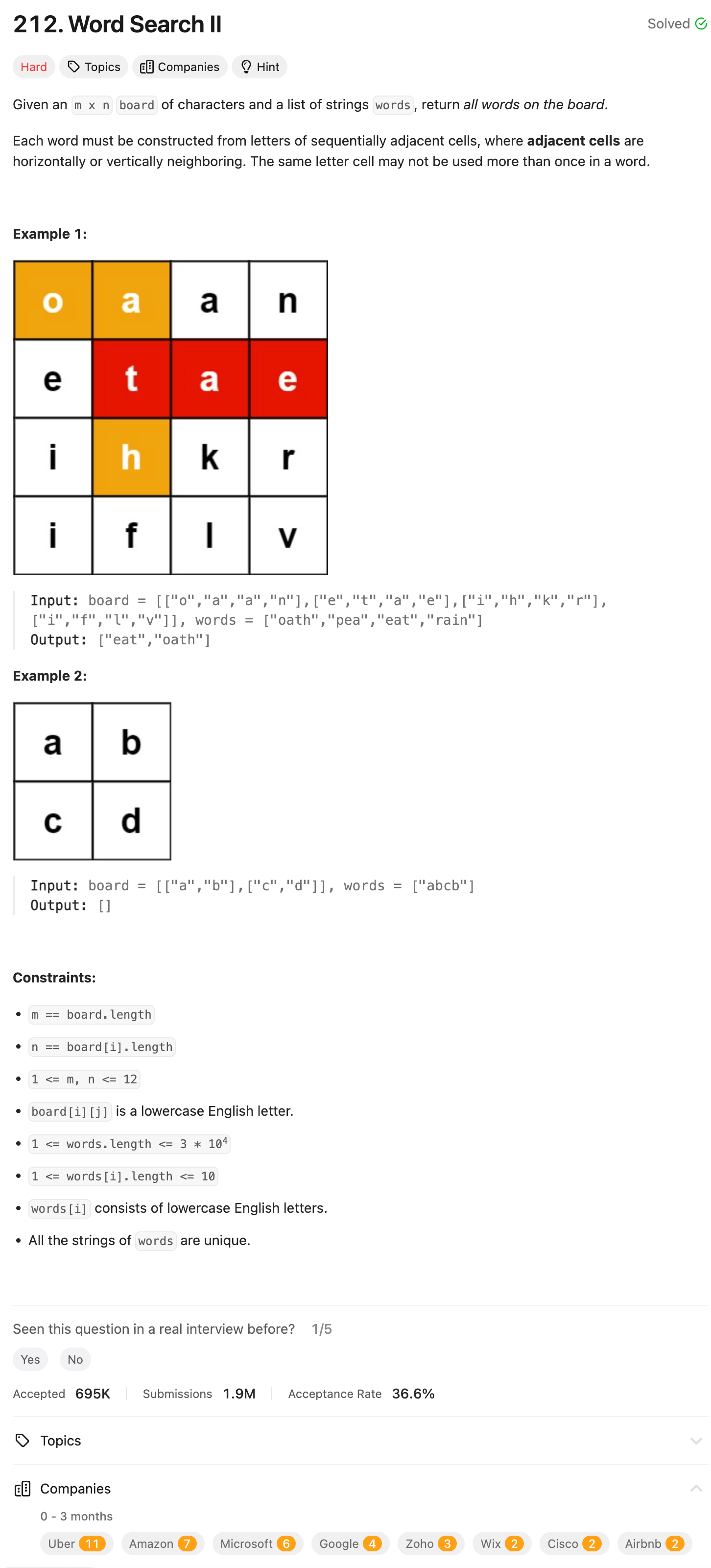
Intuition
We can efficiently solve this problem by building a Trie from the list of words and using a backtracking algorithm to search the 2D board. The Trie allows us to quickly determine if the current character on the board can form part of a word in the dictionary. The backtracking ensures that we explore all potential words that can be formed by connecting adjacent characters.
Approach
- Construct a Trie from the list of words to efficiently check if a word or prefix exists.
- For each character in the board, use a backtracking algorithm to explore all possible paths, checking if they form a valid word.
- During backtracking, mark the board position as visited by temporarily replacing the character with a special symbol (e.g.,
##) to avoid revisiting it. - If a word is found during the search, add it to the result list.
- After exploring, reset the visited character to its original state.
Complexity
-
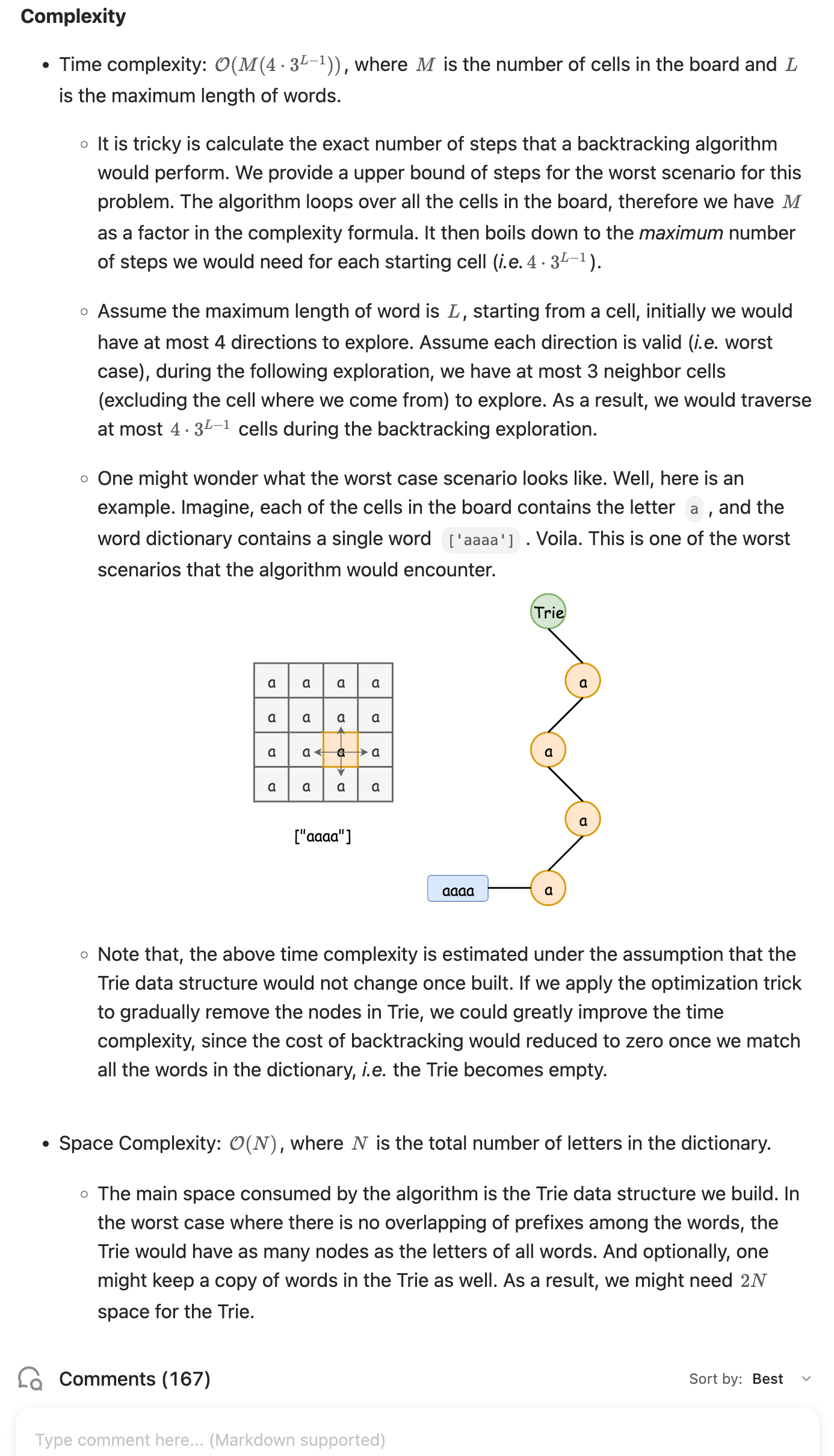
Time complexity: The time complexity is O(m \cdot n \cdot 4^l), where m \cdot n represents the size of the board, and l is the maximum length of the word in the dictionary. In the worst case, we may need to explore all four directions for each cell, leading to the factor of 4^l for backtracking.
-
Space complexity: The space complexity is O(l) due to the recursion depth during backtracking, where l is the length of the longest word. Additionally, building the Trie takes O(W \cdot L), where W is the number of words and L is the average length of the words.
Code
class Solution:
    def backtrack(self, row, col, board, res, trie):
        ROWS = len(board)
        COLS = len(board[0])
        if '#' in trie and trie['#'] not in res:
            res.append(trie['#'])

        temp = board[row][col]
        board[row][col] = '#'
        for x, y in [(1,0),(0,1),(-1,0),(0,-1)]:
            r, c = row + x, col + y
            if 0 <= r < ROWS and 0 <= c < COLS and board[r][c] in trie:
                self.backtrack(r, c, board, res, trie[board[r][c]])
        board[row][col] = temp

    def findWords(self, board: List[List[str]], words: List[str]) -> List[str]:
        trie = {}
        ROWS = len(board)
        COLS = len(board[0])
        res = []
        for word in words:
            root = trie
            for c in word:
                if c not in root:
                    root[c] = {}
                root = root[c]
            root['#'] = word
        for row in range(ROWS):
            for col in range(COLS):
                if board[row][col] in trie:
                    self.backtrack(row, col, board, res, trie[board[row][col]])

        return res
Editorial
Approach 1: Backtracking with Trie
class Solution:
    def findWords(self, board: List[List[str]], words: List[str]) -> List[str]:
        WORD_KEY = "$"

        trie = {}
        for word in words:
            node = trie
            for letter in word:
                # retrieve the next node; If not found, create a empty node.
                node = node.setdefault(letter, {})
            # mark the existence of a word in trie node
            node[WORD_KEY] = word

        rowNum = len(board)
        colNum = len(board[0])

        matchedWords = []

        def backtracking(row, col, parent):

            letter = board[row][col]
            currNode = parent[letter]

            # check if we find a match of word
            word_match = currNode.pop(WORD_KEY, False)
            if word_match:
                # also we removed the matched word to avoid duplicates,
                #   as well as avoiding using set() for results.
                matchedWords.append(word_match)

            # Before the EXPLORATION, mark the cell as visited
            board[row][col] = "#"

            # Explore the neighbors in 4 directions, i.e. up, right, down, left
            for rowOffset, colOffset in [(-1, 0), (0, 1), (1, 0), (0, -1)]:
                newRow, newCol = row + rowOffset, col + colOffset
                if (
                    newRow < 0
                    or newRow >= rowNum
                    or newCol < 0
                    or newCol >= colNum
                ):
                    continue
                if not board[newRow][newCol] in currNode:
                    continue
                backtracking(newRow, newCol, currNode)

            # End of EXPLORATION, we restore the cell
            board[row][col] = letter

            # Optimization: incrementally remove the matched leaf node in Trie.
            if not currNode:
                parent.pop(letter)

        for row in range(rowNum):
            for col in range(colNum):
                # starting from each of the cells
                if board[row][col] in trie:
                    backtracking(row, col, trie)

        return matchedWords
Leave a comment